
27/01/25
Gouldians are no longer housed in this cage instead it has a pair of Rosa Bourke Parrots (and their 7 offspring from three recent broods) and 2 Pied Red Faced Parrot Finch cocks.
01/05/24
We ended up with just two of the hatchlings pictured in the previous post, fledging from NB27. One of these young birds is quite advanced over the second bird who is yet to fly up to the upper perches in the cage. The third hatchling was actually trampled to death by its two brethren (we discovered this when we cleaned out the NB27).
The second pair in the cage who were not successful with their first two broods, seemed to have got it together with their current brood of 4 eggs. We suspect there are now hatchlings in NB17 given the activity of the parent birds/timing. We wait in anticipation!
31/03/24
In the previous post we mentioned that we hoped to have the six Gouldians pair off. This happened for four birds who paired up and settled into nest boxes 17 and 27 in the cage. With the other ‘pair’, we ended up removing the cock bird from the cage after it became obvious he had lost ‘condition’ to breed (generally fluffed up all the time and having trouble reaching higher branches in the cage, so placed in Cage 41/42 to monitor and since has had to be put down).
With the two pairs of Australian Yellow Gouldians that went to nest, we have had a mixed results.
The pair in NB17 started with a brood of 5 eggs which were abandoned shortly before they were due to hatch. An inspection of the abandoned eggs revealed 5 fully formed embryos about to hatch. This pair did the same thing with their second brood of 4 eggs abandoning the nest just short of the expected hatch date. This time however there was only one fully formed embryo and 3 infertile eggs.
The pair in NB27 had a similar start to the breeding season as the above pairing ie abandoning their first brood of 6 eggs just short of their expected hatch date. When inspected, the abandoned eggs revealed 2 fully formed embryos and 4 infertile eggs.
Fortunately, with their second brood we have 3 hatchlings from a nest of 4 eggs – pics below of the 3-4 day old hatchlings and unhatched egg that acts like a ‘hot water bottle’.

01/01/24
Another cage with some changes to the Gouldian birds held here. Hopefully we will see three pairs breeding if all things go well.
The pair of Bourke parrots in the cage are now resting (not breeding) while the pair of King Quail who recently produced a clutch of 6 hatchlings (chicks now sold) are doing fine on the floor keeping it clean. See pic below of King Quail (Tuxedo mutation) adults and chicks.

A picture of one of the Gouldian hen birds is below.

09/07/23
To start off with, the two Quail and the pair of Bourke parrots are doing fine and have produced no progeny as yet. There was also a Blue Gouldian hen in this cage for most of the period but we moved her ‘indoors’ to Cage 41/42 in the last week.
Meanwhile the pair of the Australian Yellow cock and Normal split Australian Yellow hen have produced fledglings from two successful broods (including the last lot of fledglings for 2023).
Their first brood consisted of two Normal split Australian Yellow birds (now housed in Cage 37/38) and a small Australian Yellow which died after 5 days out of the nest box due to the cold. It was never able to fly up to the higher perches where its split Yellow siblings were (see these two birds sitting with their hen parent in the pic below).

Below are a couple of pics of the deceased bird before the cold got to it.


The second brood produced just the two birds which were both Australian Yellows and are pictured below.


07/04/23
Since our previous post we have added one of the quail ‘chicks’ from the Main Aviary to be with ‘Hoppy’ the one legged male quail in this cage. The quail ‘chick’ is now adult sized and is a hen bird who has settled in well with her new male companion.
The Bourke Parrots in this cage have been threatening to go to nest for weeks now, but still ‘no cigar’ as they say.
Meanwhile, the pair of Gouldians incubating eggs in NB26 per the previous post ended up abandoning the brood. The pic below shows the result of their first brood!

This same pair are now incubating a second brood of 6 eggs which are due to hatch in the next week – hopefully better luck this second time around.
The second pair of Gouldians in the cage (which include a Blue Gouldian hen), are yet to start a brood.
05/03/23
Been a bit of a slow burn in this cage with all the different birds. We lost a Quail earlier in February who had fathered a whole brood of quail chicks in the Main Aviary which left us with ‘Hoppy’ a one legged quail who hops around the bottom of the cage eating all the scrap seed.
The parrots have been together for some time and did have a clutch of 4 eggs pre Christmas 2022 which came to naught so we are watching a waiting for them to go around a second time (hopefully soon).
This leaves us with the four Gouldians. We currently have an Australian Yellow cock and split Australian Yellow hen incubating eggs now for around two weeks – hopefully due to hatch in a couple of days.
The other pair of Gouldians in the cage are our Blue Gouldian hen and the BH WB split Australian Yellow cock. He has built a nest but is having some trouble getting the hen bird to ‘commit’. We will watch this space with interest!


27/10/22
Most of the Australian Yellow fledglings that were ‘born’ in this cage (per the pics in the previous post) remain therein, while we added the AVB and Blue Gouldian birds in from other cages as part of our regrouping of birds after the breeding season.
We also moved a pair of Bourke Parrots from the Main Aviary to assist with them possibly breeding before the end of the year.
20/04/22
As per the previous post, we had a pair of Australian Yellow birds with a brood of 6 eggs in NB25. Well, a couple of weeks ago, five fledglings came out from the nest box and all are quite fit and making themselves at home in this cage. Some pics are below.
This has been the only formal pairing/breeding of young birds from Aviary 2 this season. We have cleared out a number of infertile eggs from the other three nest boxes in the cage laid randomly by any of the four Normal hens. It would have been nice if they had paired up with either of the two Blue Gouldians cock birds in the cage!


20/03/22
We mentioned in our previous post that a newly added Australian Yellow hen bird (to this cage), had gone to nest – in the end she laid seven eggs and this week we could hear hatchlings coming from NB25. We will monitor the cage over the coming week as this will be her first successful brood in 3 years.
Her picture is below along with the Australian Yellow cock bird she has paired up with.


With respect to the remaining seven birds in this cage, we have seen some random egg laying by a couple of the hens (we have since removed the eggs from the nest boxes), but haven’t seen any formal ‘pairing’ with the 3 other cock birds in the cage.
03/03/22
Since our last post we added the mature Australian Yellow hen from Cage39/40 back into Aviary 2 and she has immediately gone to nest with one of the Australian Yellow cocks in NB25, so looking forward to more Australian Yellow fledglings this season.
None of the other birds in the cage have paired up yet, maybe as all the remaining hens in the cage are ‘first’ year birds.
08/02/22
Not much to report from this cage since the post other than one of the hen birds mysteriously dying in the last 48 hours.
In this cage is the Pastel Blue cock who does not look to be in breeding condition at all, so we decided to initiate a worming program a week ago to see if this might help with his general demeanour, but it doesn’t seem to have made a difference yet.
An odd thing did occur in this cage some weeks ago when we we setting some of the perches. We found two eggs in the cage – one on the floor and one in NB24 that were remarkably different in size to each other as per the pic below. As the cage only has first year hens in it, we can only assume they are still to come good with egg laying in their first breeding season.

20/01/22
We placed nest boxes in this cage earlier this week – the pic below shows birds in and around the nesting boxes. To date, none of the birds have really taken to a particular nesting box.

The expected progeny from any breeding combinations in this cage will either be green bodied split Australian Yellows and green bodied split Blue Gouldians as all the males in the cage are Double Factor for their respective body colour (ie Blue/Australian Yellow) and all the hens are Normal with no colour mutations. NB – it is possible the progeny from a pairing including the Pastel Blue cock, may produce Single Factor Pastel green birds due to the Pastel Blue cock having a single yellow chromosome for body colour.
03/01/22
After holding all our 2021 fledglings for the recent Winter and Spring seasons, we have moved a number of birds in and out of this cage today.
We moved three hens to Cage41/42 (holding stock), and one hen each into Aviary1 and Aviary3.
What remains are five Normal hens (all bred 2021) along with two Australian Yellow cock birds (also bred 2021) plus the addition of a Blue Gouldian cock and Pastel Blue Gouldian cock.
We will introduce nesting boxes in the next week or so when the birds have settled a bit after the shake up of the cages population today.
Below is a picture of some of the birds in the cage this afternoon.

21/07/21
We determined some weeks ago that the adult birds in this cage were not going to have any further successful broods for the 2021 breeding season, so placed all the adult birds into other Cages and moved 4 Normal fledglings from Aviary 1 into this cage so we have 10 x 2021 fledglings now in this cage. Picture of them is below.

28/05/21
A lot has happened in this cage since our last post. Firstly, we had a second brood of 3 fledglings emerge from NB26 to our split Blue pairing. Unfortunately there were no Blue Gouldians amongst the 3 chicks as all are Normal in colouring. They are close to being fully weaned.
There was some bad news however associated with their emergence from their nest with their male parent (pictured below – RH WB Normal split for Blue), dying shortly after.
We came out one morning to find him dead on the cage floor with an empty ‘crop’ and a dirty vent. We are not clear why he died so suddenly as he had been active in caring for the 3 fledglings the day before.

In other news, we transferred a pair of split Blue birds from this cage to Cage 35/36 on 26 April to see if being ‘alone’ in a smaller cage may have them go to nest. To date they have not.
We had a most unusual situation arise in this cage with 3 adult birds. We had a cock bird sitting across two nesting boxes. In one nest box (NB27), as reported in the previous post, he had a brood with a SF Pastel Green split for Blue hen. This ended up comprising an infertile egg and a couple of dead hatchlings tossed from the nest box. At the same time he was sharing a brood with an Australian Yellow hen in NB26.
We had thought the hen was trying ‘solo’ to raise a brood (which would have been infertile), as she had done this already on a couple of occasions this season, but lo and behold, when we checked the nest box (when clearing out NB27), we found two week-old hatchlings therein!
Unfortunately, our disturbing the nest caused the birds to abandon it the next day with the hatchlings dying a couple of days later.
13/04/21
In our last post we excitedly announced the emergence of three new fledglings including a Blue Gouldian. The three birds are all healthy and now weaned from their parent birds who are currently sitting on a second brood which are due to hatch any day now (NB26), so we may have a further Blue Gouldian to report on in the near future.
In this cage there is also a second pair sitting on a brood (NB27) which is due to hatch in the coming week – this is the same pair that tossed the chicks from their first brood for the season. Hopefully they will allow the hatchlings to go full term this time around.
There are two other potential pairs in this cage, but they have not ‘paired up’ as we would have liked and we will look to move them from the cage when it is possible (we don’t to disturb the sitting birds for now).
Some pics below of the two Normal coloured fledglings and a ‘full back’ photo of the Blue Gouldian fledgling – you can see its darker feathers compared to its Normal coloured siblings.


21/03/21
This cage is where all the excitement has been this week with the fledging of three chicks to a Normal split Blue pair (male parent is RH/WB while the female parent is RH/PB).
Plenty of pics below of the three birds after emerging from NB26 four days ago.
This first gallery below shows the two Normal fledglings who predominantly have a green back. Their male parent is the RH/WB Green backed bird in the pic, while the other bird in the pics with the variegated back, is a RH Australian Yellow.


In the gallery below are pics of the Blue Gouldian fledgling in various ‘poses’. In the pics it is a little difficult to see its ‘blue’ back, so we will look to get better pics for the next post.


14/03/21
With much excitement we found out today that one of the three hatchlings in NB26 is a Blue Gouldian with the other two hatchlings being Normal Gouldians but also ‘possible’ Blue splits.
The parent birds of this brood were also responsible for a brood in 2020 that included three Blue Gouldians and one Normal.
The three birds were well feathered when we completed the nest box check today and we estimate they should be out flying next weekend.
In our previous post on 14/02 below, we mentioned a second pair also sitting on a brood. Unfortunately their brood of 4 hatchlings were all tossed from the nest box shortly after they hatched. We are certain the ‘ruckus’ caused having to treat all 6 birds in the adjoining Aviary 3 for air-sac mite, caused the parent birds to panic and toss the chicks as it occurred within 24 hours of the Ivomec course of treatment.
We have since purchased a new solution for treating the birds via their water (Moxiedectin).
This pair have now started with a second brood about four days ago, so all good.
The other two pairs in the cage have not been as interested yet in breeding. Time will tell if they start something over the coming weeks.
14/02/21
After much consideration around what we wanted to do this breeding season in this cage, we have selected the stock as listed in the subject line as we are most interested in breeding more Pastel Blue cocks and hopefully Silver birds. To this end, we have three pairs that carry combinations of Blue/Yellow bodied ‘factors’.
We have also thrown into the cage, a pair of Split Australian Yellows which we expect not to mix with the other six birds which are all ‘paired’ – so much so, that two pairs are already incubating eggs in NB26 and NB27 and the third pair are busy inspecting NB24.
The two pairs incubating have been for just on a week and with the weather being mild for this tim eof year, we expect they should have successful first up broods.
Pictures of the set up in Aviary 2 below.

26/12/20
Time for an update of the birdlife in Aviary 2 and what we propose for the 2021 breeding season in this cage.
Currently we have 5 birds in the there – a full Australian Yellow cock, a split Australian Yellow hen and cock and a SF Pastel Green split Blue cock and Normal split blue hen (who raised the Pastel Blue cock from last season).
We had a further split Australian Yellow hen in the cage until two days ago, but she in now in the hospital cage (Cage 33/34) with what appears to be a nerve/muscular problem around her shoulder region. It would have meant having 3 pairs in the cage and so we will think again about the cages set up – possibly take a pair out of the Main Aviary which currently has 7 pairs which is really 1-2 pairs too many.
24/5/20
We completed some minor re-shuffling of birds in this cage removing three blue derivative birds (placed into Main Aviary) and adding the Pastel Blue cock bird (fledgling).
In the previous post we were hoping for good news with the pair sitting in NB27, but the nest box was abandoned in the middle of last week and nothing came of a possible nest in NB26.
We will likely remove all nest boxes from this cage during the week when the weather is less wet/cold.
10/5/20
The parent birds of our three Australian Yellow fledglings continue to brood in NB27, so we are hoping we get another 2-3 birds of similar type.
We also suspect a pair of split blue birds have nested in NB26.
Pic below of all the current inhabitants in this cage – can you spot the three AY fledglings?

30/4/20
Just a couple of things to note coming out of this cage since the last post.
We placed plastic numbered rings on the three Aust Yellow fledglings. The exercise gave us an opportunity to more closely study the birds and we believe one of the three is likely a split Aust Yellow (the one with the darker chest colour), while the other two should be full Australian Yellow birds with the much lighter chest markings.
The other thing to note from the cage this past week was the hen bird of the fledglings commencing another brood in NB27.

20/4/20
A bit of movement into and out of this cage during the week after the three Australian Yellow hatchlings ‘fledged’ as per the pics below. Unfortunately the fourth hatchling in NB27 didn’t make the big stage and was abandoned by the parent birds.


We moved four split Australian Yellow birds ‘out’ of this cage and brought in three new pairs from the cages located on the back verandah which included a Blue Gouldian cock bird and various split Blue birds (which we are more interested in breeding together at this late stage in the the season).
11/4/20
Just adding another pic of the 4 hatchlings to this page (as well as on the main blog page).

In another nextbox (NB25) there were 7 abandoned eggs from the young hen we have in this cage. We will be moving her in the next 24-48 hours to stop her breeding.
6/4/20
Some better pics below of the hatchlings in NB27 which more feathering noticeable these last few days. The hen bird is an Australian Yellow while the cock is a split Australian Yellow, so we should get a 50/50 split of pure Aust Yellows and Split Aust Yellows.


We found 6 eggs today in NB25 with the hen bird who has laid many eggs this season for no return.
3/4/20
All going well with the 4 hatchlings in NB27. Below are a couple of pics taken during the week. The pics are four days apart (Sunday and Wednesday), but you can make out the increased feathering of the biggest bird amongst the four.


These hatchlings parents are an Australian Yellow hen and an Australian Yellow split cock.
Meanwhile, one of the other hens in the cage has started laying eggs (3) in NB25. She has already laid a staggering 33 eggs this season (she was the hen bird responsible for the 14 eggs in thepost of 21/3 for this cage). We expect this brood (her sixth) will go the same as all her previous broods – abandonment after 1-2 weeks. She is an example of a first year bird who has paired up with a first year cock (her brother) and neither really know what to do in this, their first breeding season. We will likely move her into a cage without a nestbox in the next week or so to stop her laying.
28/3/20
Well – do we post the good news first or the bad news? Let’s start with the bad news.
In the previous post we showed NB26 with a brood of 6 eggs close to hatching. Shortly after our last post, the eggs started to hatch, but the parent birds ‘panicked’ (likey the cock bird) and started tossing the 1-2 day old hatchlings onto the cage floor (3 in total). Clearly the parent birds then abandoned the nest box, so we removed the remaining three eggs – 1 which was infertile, while the other two had almost fully formed unhatched chicks inside – very disappointing.
But the good news is with NB27 where we have 4 hatchlings around a week old. It hasn’t been all plain sailing for the pair however as we removed one dead hatchling from the nest box and noticed a couple of unhatched eggs still in the nest. Nonetheless, we potentially have a couple of Australian Yellow hatchlings with the hen being a full Aust Yellow and the cock a Split Aust Yellow.
21/3/20
As per the main post this week, we completed a nestbox inspection in Aviary 2 today and in NB25 found the hen had laid 14 eggs over a 3-4 week period.
The better news however is in two other nestboxes in the cage where the hen birds are sitting on broods close to hatching. We were able to evidence that with the brood of 7 eggs in NB26. We used an egg candling torch and found 6 eggs almost ready to hatch and 1 infertile egg which we removed before taking the pic below.

We were also keen to see what the state of the nation was in NB27 but the hen bird wouldn’t budge when we checked the nest box, so we can only assume she was being protective of potential 2-3 day old hatchlings that we suspect she is sitting with.
14/3/20
This is a most frustrating cage with the birds probably being too young to manage their broods. Last time we reported all three hens with broods. Well as of today, only two hens (and their partners) are incubating eggs as one of the pairings (NB25), left the brood after about a week.
We may have something to report next time about having hatchlings possibly from one of the remaining two ‘inhabited’ nest boxes (NB26 and NB27) else we may just end up reporting another 2 lost causes!
4/3/20
In the last post we advised how we had removed many abandoned eggs from the various nest boxes in this cage.
Well the pairs haven’t taken long to reset and all three hens in this cage now have broods with two pairs having 6 eggs in each of their broods (in NB25 and NB27).
23/2/20
So much for all the ‘good’ news from last week…see the pic of the nest box 26 with 15 abandoned eggs that we removed two days ago.

In the end we removed 25 eggs from the four nest boxes in the cage – all abandoned!
All the birds in the cage are in their first year of breeding, so that may have something to do with their failure to bring out any young birds with these broods this time around.
16/2/20
OK…the good news in this cage is two of the three pairs are sitting on eggs, so we have our fingers crossed there will finally be some success in this cage with new fledglings instead of abandoned broods of eggs only!
8/2/20
We suspect the pair who had the brood of 7 eggs per the previous post, have started on a further brood as one of the pair is constantly in a nest box when we randomly check the cage’s inhabitants. We haven’t physicaly checked the nest boxes for a week as we don’t want to diturb the birds unnecessarily if they have actually started a new brood.
We also suspect a second hen has started laying – we have not ever seen her in a nest box although we had her also in the 2019 breeding season.
She is a full Australian Yellow.
For this cage it is a bit of ‘watch this space’ for now.
2/2/20
We cleaned out another abandoned nest today from this cage where 7 eggs were removed from NB 26. Five of the eggs were fertile, so disappointed the parent birds didn’t stay the course.
Nothing else to report as none of the three pairs in this cage have laid a new clutch this week.
Pic below of some of the birds enjoying some fresh cuttlefish to chew on.


27/1/20
This cage has moved from 4 pairs to 3 pairs of birds.
We removed a pair of birds that had the brood of nine eggs as reported in the previous post and palced them in Cage 31/32. Of their brood only two hatched and both died shortly afterwards. The pic below shows the tragic tale of the nest box.

While all this was happening another of the hen who had 5 eggs per the previous post, extended her brood to seven eggs, but we think she has already abandoned them after only sitting for a week. We are not sure why, but the birds in this cage had been fairly ‘disruptive’ towards one another, hence a reason for moving one of the pairs out of the cage for now.
At the same time as removing a pair of birds, we also ‘swapped’ over another of the hen bird. We removed a hen out of this cage and placed her in Cage 11/12 but added the hen from Cage 9/10 into this cage. We were able to maintain an Australian Yellow flavour still in ths cage after all the changes!
16/1/20
When we checked the nest box today with the 9 eggs, we found two tiny day old hatchlings had arrived!
This is our second set of hatchlings to arrive this week (the others are in Aviary 1).
While in the cage we also found another pair of birds had already produced a clutch of 5 eggs.
The nest box with the three eggs (whose ownership we were unsure of per the last post), has been cleared of its abandoned eggs today (see pic below). We supect these three eggs belonged to the couple who decided to move to a new nest box and now have the clutch of 5 eggs.

This last couple comprise one of the four Australian Yellow Split cocks in this cage and the Normal Australian Yellow split hen.
9/1/20
Well another check of the nest boxes showed the pair with seven eggs in the previous post now have nine eggs! The parent birds have been brooding the clutch for 9 days now.
We are convinced the hen bird from this couple is also responsible for three abandoned eggs in another nest box in the cage, so we removed them today to ‘free up’ the nest box for another couple to use.
We found in a third nest box, three eggs recently laid but as we have a ‘colony breeding’ set up in this cage, we are yet to determine who the parents are – we will watch with interest now we know there are eggs in this new nest box.
3/1/20
A check of the nest boxes today revealed a pair suspected of starting to lay, have seven eggs!
Another nest box had three eggs but we have not been able to ascertain who the hen bird is of this clutch or whether the eggs were also laid by the hen sitting on the seven eggs….we’ve seen it happen before where a hen laying for the first time in the season, spreads her egg laying across two nest boxes.
Below are various pics of the different birds in this cage. The cock bird responsible for the seven eggs is in the pic munching on the millet spray. All four cock birds in this cage are brothers from two separate 2019 broods, and are split Australian Yellows with heavily variegated backs and lilac breasts (ranging from a light smattering to heavily marked patches of lilac).


25/12/19
We have recently added a further hen bird to this mix of Australian Yellows and Split Australian Yellows, so have the potential for 4 pairings.
The birds in this cage are quite feisty. The four cocks are all brothers, but from two seperate 2019 broods. We like to call them the ‘four brothers’ for short.
Like any normal set of siblings, they are extremely competitive for the attention of the four hen birds – one being their sister!
Below is a pic of the birds which now includes the Black Headed (expressed as white) Australian Yellow hen.

18/12/19
At least one of the potential four pairs in this cage have selected their nest box (as well as each other), so we will watch to see when they start their brood.
The rest (including the new Black Headed (expressed as white) Australian Yellow hen we purchased on Tuesday), are still picking fights with each other (the four cock birds are brothers from two different broods from 2019).
Some pics below with the four brothers (heavily variegated backs) all pictured in different parts of the cage (including in the pics from the previous post).


14/12/19
We decided to remove some more birds from this cage to make it exclusively an ‘Australian Yellow’ playground.
There are seven birds remaining in the cage.

12/12/19
We moved a number of birds from this cage yesterday/today as part of preparing the birds for the 2020 breeding season.
Over the week-end we will move more of these birds around – specifically into Aviary 1 as we determine pairings for the birds in this cage which are mainly Australian Yellows and split Australian Yellows.
8/12/19
These guys are starting to get a bit restless (they know the breeding season in imminent) with some fantastic coloured birds coming through as most have now finished or finishing their moult in this Aviary. See pics below.


23/11/19
A close up pic from this cage this week where you can clearly see the moulting of feathers going on around the head of the birds. They will be fully coloured up by Xmas Day.

17/11/19
Some really exciting colour variations starting to present themselves as both the adult and first year birds come out of their moult.

6/11/19
This aviary is currently home to 11 adult Gouldians (made up of 6 hens and 5 cocks birds) and 10 young birds from our most recent breeding season (Jan-May 2019).
The young birds are now coloured up enough to determine their sex and we have 6 cock birds and 4 hen birds. Six of these youngsters are from the same parent birds (one being the black headed Australian Yellow cock bird). They all look healthy and at the moment, the young cock birds competing with the much older cock birds for the attention of any hen bird that will listen!
Pic below of birds in this Aviary taken in August.

24/6/19
We have moved the Gouldians from Aviaries 1 and 3 into Aviary 2 yesterday as well as the Yellow pair of Gouldians from Cage 39/40. All nest boxes have been removed to rest the birds.
There are now 22 birds in this Aviary 2 (which is the largest of the three cages linked together we refer to as Aviaries 1-3).
We will spend some time improving the ‘warmth’ factor for this cage going into winter.
25/5/19
Today we cleaned out the left hand nest box in this cage that had been hijacked some weeks ago by the normal Gouldian couple.
They had been sitting on 5 eggs initially and then 4 eggs before we noticed two 1-day old hatchlings and one other egg in the nest box, earlier in the week.
This all looked good, except the parent birds immediately abandoned the nest, so the two hatchlings died and the unhatched egg which contained a fully grown embryo, was also lost.
We pulled the nest out and found the ‘missing 2 week old hatchling’ from the other pairing in the cage, dead amongst the bottom of the nesting material (which solved that mystery discussed in our post on 4/5/19). We also found some other eggs in the nesting material that had simply been built over the top of.
So we have ended up with nothing from three prospective broods over a 6 week period!
We have left the four adult birds (and three fledglings) in the cage and freshened up the nest boxes and will see whether the adult birds come thru with one more brood each this season.
13/5/19
No doubt the most ‘activity’ took place in this cage over the last 9 days.
Firstly, the sad passing of our most successful hen bird who raised 10 fledglings last season and a further 6 this season. We are not sure how she died – she had been ill for some time prior to her most recent brood but we noticed she was ok and in the nest box in the morning and then in the afternoon, found her dead on the cage floor.
We were wondering if she may have been attacked by another Gouldian over the nest box as we had inadvertently left the cage one ’empty’ nest box short, and her frail state meant she was easily killed protecting her patch(?).
We are not sure if this is really the case as the Gouldian breed doesn’t seem to be as aggressive towards each other as canaries are for instance.

As a result of her death, the brood of six eggs she and her partner were incubating were abandoned and subsequently removed from the cage. We also moved her partner (DF Pastel Green cock) and placed him in the Main Aviary to leave just the two adult pairs and 3 fledglings in the cage (as we also moved 13 fledglings into the Main Aviary this last week).
The most successful partnering this season (11 fledglings so far…) are still incubating 5 eggs in the left hand nest box they took over the other week. The bird on the left in the pic above is the hen bird of this successful partnering.
4/5/19
So much has changed from the list below, so to re-cap:
- the single hatchling is still alive in the left hand nest box and is around 2 weeks old
This hatchling has now disappeared from the cage – not sure what has happened to it
- there are at least 3 eggs (if not 4 eggs) in the middle nest box now being incubated by the older Normal hen and her DF Pastel Green partner
Still true this week with this nest box/the Gouldian pair in question
- the right hand nest box is being frequented by the Normal pair who have already had two successful broods of 5 and then 6 fledglings, and may or may not have started egg laying
Well they started egg laying alright – they laid two eggs in the right hand box, then abandoned it and took over the left hand nest box where the hatchling was a week ago, have laid a further 5 eggs which they are now incubating!
28/4/19
Ok,
- the single hatchling is still alive in the left hand nest box and is around 2 weeks old,
- there are at least 3 eggs (if not 4 egg)s in the middle nest box now being incubated by the older Normal hen and her DF Pastel Green partner,
- the right hand nest box is being frequented by the Normal pair who have already had two successful broods of 5 and then 6 fledglings, and may or may not have started egg laying
So…all good
22/4/19
The five new fledglings are doing fine having been out of the nest box for just over a week now. Initially three, then two of the fledglings remained on the ground for five days before being able to comfortably fly up to the perches that are high up in this cage.
The other eleven fledglings in this cage from earlier broods are ready to move into the Main Aviary and we will likely move them in the next week or so.
In the nest boxes, we have a single hatchling almost a week old to the mother/son pairing in the left hand nest box. As usual, a single hatchling represents a challenge to itself in staying warm at night without siblings for body warmth.
In the middle nest box is now three eggs and we are still to establish which of the other pair these belong two, while in the right hand nest box, clearly nest building is going on therein which we suspect belongs to the DF Pastel Green cock and Normal hen.
17/4/19
We placed yellow coloured numbered rings (45-49) on the five fledglings in this cage two days ago and took a picture with each bird while doing so – hard to tell the difference between any of the five birds whose parents are Normal in colour and we expect all five of these birds will be the same Normal colouring.


A quick check of the other two nest boxes revealed the mother/son pairing have still just the one hatchling as of today, so we don’t expect the other three eggs in the nest box to hatch after all.
In the third nest box in this cage we found two eggs and are yet to determine who these belong to, so will watch with interest. However it is likely they belong to the Normal pair as with their first brood, they quickly moved to caring for their second brood well before their fledglings were weaned (usually 3 weeks out of the nest box).
13/4/19
Well two days ago, the first of the 6 recent hatchlings left the nest box but unfortunately escaped from the cage and we were unable to recapture it. This means we have 5 new fledglings out in this cage in the last couple days.
A picture of three of the newbies is below. As you can see by their colouring (olive green back/grey heads/light brown bodies), they will be Normal coloured birds when they reach maturity

This cage has been the most successful ‘breeding’ cage this season and with this third lot of fledglings, we now have 22 birds in this one cage!
See pic below of many of the old and young birds now in this cage including a couple of the newbies who are not on the floor still (the coloured birds are the parent birds).

We also have another nest box of week old hatchlings in one of the nest boxes in this cage, but are yet to get a picture of the recently hatch birds yet. Will hopefully have a picture next week.
6/4/19
Those 6 Normal hatchlings from the previous post are close to fledging – we expect it any day now.
We will need to place further perches in this cage as we will have 17 youngsters and 6 adult birds in the cage once this lot fledges.
There is another pair of birds incubating a clutch of 4 eggs which we expect to hatch tomorrow or the day after.
1/4/19
We have latest pics of the 6 hatchlings belonging to the Normal pair in this cage below.

Clearly all the youngsters are taking on the features of there parents with their dark feather colouring to date.
Meanwhile, the mother/son combination in the cage continue with their formal brooding of their clutch of 4 eggs.
No activity from the third pair of birds in this cage – we think the hen bird who was quick unwell thru the start of March, has lost interest in breeding again this season.
27/3/19
Yesterday we removed the Blue Gouldian hatchling, that had died, from the nest box with the six Normal hatchlings who continue to do well – they are 11 days old now and starting to ‘feather up’.
The mother/son Pastel Green pairing continue the formal brood of their 4 eggs – their second brood this season.
25/3/19
Updated pics of nest boxes in Aviary 2. Hatchlings now 9 days old and a clutch of 4 eggs in the brood to the SF Pastel Green Hen and her son (SF Pastel Green as well).
NB – this pic taken of the 6 hatchlings is prior to our ‘adding’ the Blue Gouldian hatchling to the nest box some 2 hours later.


24/3/19
No doubt this cage is where all the action is taking place (again)!
The Normal hatchlings are doing fine as per the pic below (we removed one of the unhatched eggs, and you can see the ‘ring’ around the egg remaining indicating its infertility).

We also have the ‘pastel’ mother /son pairing in this cage now onto their second formal brood this last week with a clutch of 4 eggs. Hopefully we can get past the initial hatchling phase this time around (as their first brood of hatchlings all died within 2-3 days of hatching)
The hen bird in this cage that was not well a couple of weeks ago, appears to be ok now.
17/3/19
The good news for the day comes from this cage with the Normal pairs’ brood now hatched/hatching, as a check of the nest box today revealed 6 hatchlings and two unhatched eggs.
The chicks looked healthy and we will get some pics later in the week.
The other two pairs of Gouldians in the cage are currently fighting over a single nest box – for the first time we can remember, we seen 4 birds in the one nest box and could hear them squabbling before all flew out.
To help with the decision making, we moved a nesting box that was previously hanging at a lower position on the wall. We placed it between the existing two nesting boxes along the back wall so now all three nesting boxes (which includes the nesting box with the recently hatched brood per the first paragraph), are at the same level at least.
We suspect these other two pairs will soon be egg laying again.
13/3/19
Well the six fledglings are doing fine although their mother continues to look unwell. We had her in a hospital cage for a couple of days and treated her for air-sac mite and then returned her to the cage, but she hasn’t attended to the feeding of the fledglings (with their feeding being solely conducted by the cock bird).
We’ll continue to monitor her.
The mother/son Gouldian finch combination in this cage lost their brood of 4 earlier this week (9/3/19). There were three dead ‘1 day old’ hatchlings and one egg when we checked the nest box after noticing the parent birds no longer attending the nest. We don’t know why the hatchlings died other than thinking the parents may have been frightened from the nest box at night and the hatchlings died of cold (being only one day old).
The Normal pair still have their clutch of 6 eggs which should commence hatching in the next day or so.
6/3/19
The hatchlings in this cage (noted in the posts below), have now all fledged. Interestingly they came out on separate days in pairs over a six day period. The youngest pair left the nest box yesterday and are yet to leave the ground – see pic below.

We spent time this morning placing red numbered rings on the legs of each of the six fledglings. Each bird is pictured ‘close up’ below and you can see a close up of the red ring number 72 on the leg of one of the youngsters. You can also see how 4 of the birds are more distinctly yellow in colour while the other two are darker in colour.


We removed the old nest box and found it was contaminated with bird mites, so washed it out and sprayed it with mite spray before placing it back in the cage.
The female parent of these fledglings however appears to have been infected by the mites, so we removed her from the cage and medicated her and placed her in a hospital cage where she’ll stay for a couple of days. This means leaving the cock bird with the responsibility for feeding the 6 fledglings on his own for a couple of days.
Meanwhile the other two pairs in this cage are formally brooding clutches of 4 eggs (mother/son pairing) and 6 eggs (normal pairing).

25/2/19
Latest pic of the 6 hatchlings that should be out of the nest box at the end of this week. You can clearly see the ‘colour’ variations with this lot and they can also see us with their eyes now wide open!
We are thinking we have two Normal Gouldians cock birds (darker birds in middle/bottom right), SF Pastel Green hen bird (top right hand with light coloured beak), while the remaining three birds likely DF Pastel Green cock birds like their dad.
This is a slightly different ‘computation’ to what we thought we had in the post on 17/2/19 where we thought we had 4 SF Pastel Green cock birds. Hindsight is a great teacher!

Also in this cage, the mother/son combination have commenced formal brooding a clutch of 4 eggs, while the successful parents of the five fledgling in this cage have commenced a second brood with 2 eggs so far after resuming their efforts in the right hand nesting box on the back wall.
20/2/19
We managed to get a pic of all five fledglings together today as they posed for a family photo.

Their parents have started to get the right hand nest box ready for brood number two. When that happens and the hen commences laying, it will be left with the cock bird to feed the fledglings until they are weaned – usually between 2-3 weeks after they leave their nest box.
In the left hand nest box, the six hatchlings are still doing fine as per the pic below. Interesting how the hatchlings are lined up in the nest with the light coloured birds (who take after dad), up the top of the pic and the dark coloured birds (who take after mum), at the bottom.

In the nesting box on the wall facing Aviary 1, the Gouldian pair (mother and son) have 4 eggs in the clutch at present. We identified and removed the ‘old’ egg pictured in an earlier post a couple of days ago.
17/2/19
Things are humming along in this cage with the 5 hatchlings belonging to the Normal Gouldian pair having fledged over a 3 day period starting 13/2/19.
In the pic below are two of the five fledglings. Four are noticeably bigger than the fifth bird who can’t fly up to the higher reaches of the cage yet, and spent his first couple of days out of the nest box on the floor of the cage. Fortunately the nights have been mild and he has survived ok.

The six hatchlings in the left hand nesting box are getting bigger with each viewing – below is a pic after 15 days.

We believe amongst this lot we have:
- a normal bird (top/dark coloured bird),
- four SF Pastel Green cocks (light coloured wings/dark heads), and
- one DF Pastel Green hen (i.e. smallest bird furthest to the left)
Finally, things have taken a bit of a twist with the nesting box on the wall facing Aviary 1. In the previous post we noted the one egg, which we think is now no good and a second egg laid some 5-6 days later. It may be possible the eggs were laid by different hens with the first laid by the remaining Normal hen in the cage and the second by the recently added SF Pastel Green hen. We will check the nest box again tomorrow and will move the Normal hen out of this cage and into Aviary 1.
Pic of the eggs in the nest box below. Note the discolouration of the egg on the left which we suspect is the first laid and now, a ‘no good’ egg.

11/2/19
Another pic of the 6 hatchlings a couple of days later…they grow quite quickly thru this period as you will note with the start of pin feathers on the wings of a couple of the birds as distinct from the previous pic from 2 days ago.

Also in this cage are the five ‘almost ready to fledge’ hatchlings that we have no recent photos of as we are reluctant to disturb the young birds and unnecessarily predicate them ‘fledging’ a day or two early which could have disastrous effects if the weather turns poor.
The third pair in this cage have now laid their first egg, so we took time to add a pic to celebrate the occasion!
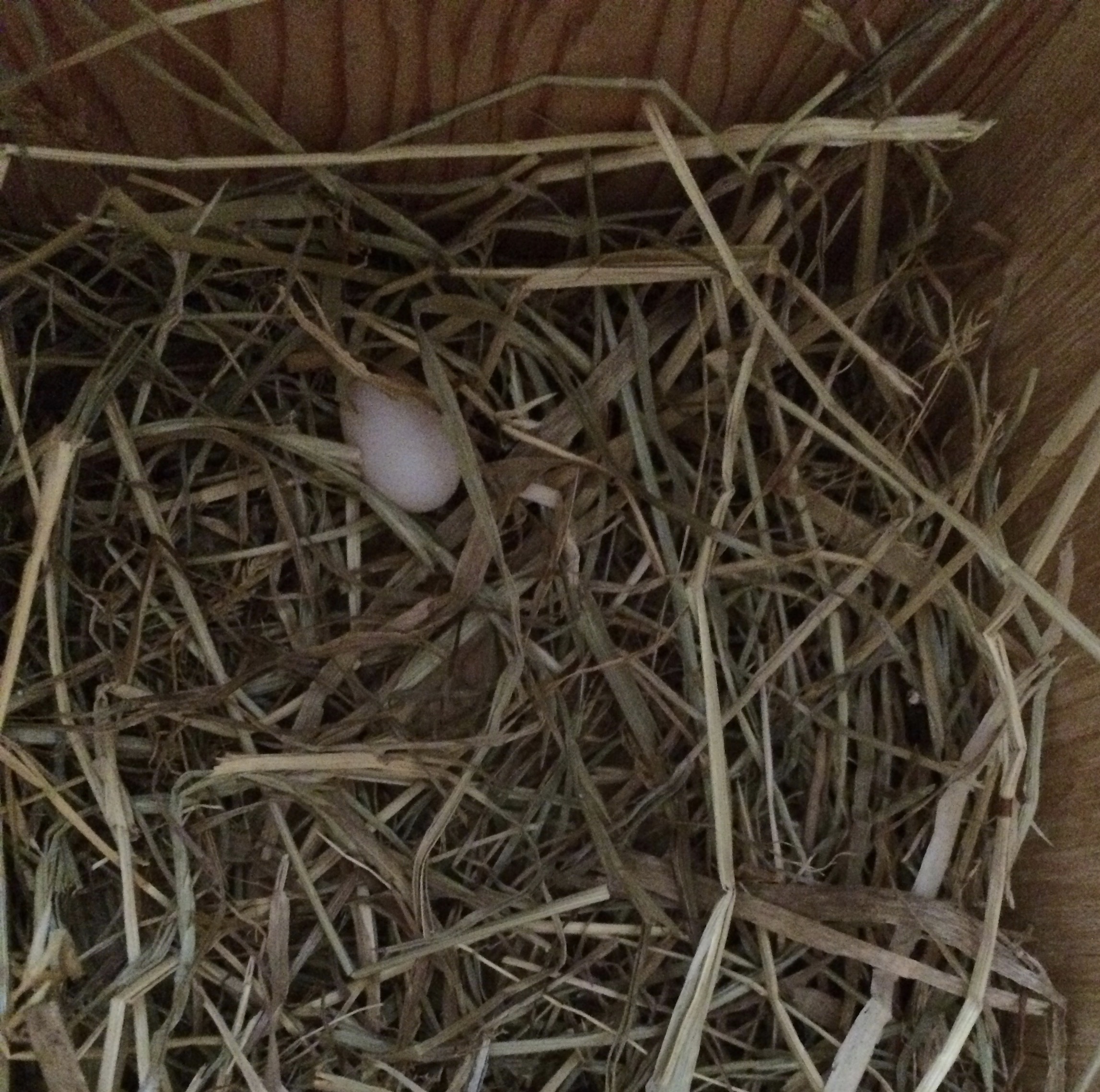
9/2/19
All looking good with the two broods in Aviary 2. The older brood have now hit the 3 week mark and by next week, we expect them to have ‘fledged’ or left the nest. This usually takes place between 24-26 days after hatching.
We took a pic of the second brood who are a week old. Mum and dad are taking good care of all 6 hatchlings as you can see in the pic below with their ‘crops’ (neck region) filled with seed, fed to them by their parents.
The two chicks on the left can be seen gaping towards the top of the nesting box with the blue luminous nodules clearly visible along the sides of their mouths.

6/2/19
We rechecked the efforts reported in the last post of the third cock bird and realised he was just messing with our heads as there has been no formal nest build in the third nesting box.
But…there is action aplenty elsewhere in this cage.
Our oldest hatchlings (5 in total) are really starting to feather up as per the pic below and are approximately 18 days old now.

A check of the second brood of hatchlings in Aviary2 showed 6 hatchlings about 4 days old as per pic below. All their crops are visibly filled with seed fed to them by their parents.

3/2/19
We noticed this afternoon the third cock bird in this cage (SF Pastel Green) was taking nesting material into the remaining nesting box in this cage which is attached to the left hand internal wall (that adjoins Aviary 1).
2/2/19
The five hatchlings in the left hand nesting box are now around two weeks old as per the pic below. You can see in this pic compared to the one taken a week ago that the hatchlings have started to ‘feather’ up and are much darker in appearance. This darker colour is also a reflection of them being of Normal coloured Gouldian parents. Hatchlings from yellow or blue Gouldian heritage tend to be lighter in colour.

In the right hand nesting box we reported the brood having 7 eggs as evidenced by the picture taken last week. This morning we found one of the eggs was in the process of hatching (i.e. the hatchling was still half in and out of the egg), so hopefully after a couple of days we will have another lot of hatchlings in Aviary 2.
The third pair in Aviary 2 are yet to commence any nest building activities.
26/1/19
With some trepidation, we checked the nesting box of the 5 hatchlings reported on the other day.
Our nervousness was around how the very small birds had survived extreme temperatures when an adult Gouldian had not (i.e. the cock bird in Aviary 1).
To our delight and as seen in the pic below, all five are ok and are now around a week old.
Clearly on display are the luminous nodules around the young birds beaks which act as a point of reference for the parent birds when feeding them in the darkness of the nesting box.

In this same cage, the second brooding pair now have 7 eggs in the clutch (previously reported 6 eggs on 19/1) and things look fine as per the pic below.

21/1/19
The first of the brooding pair in this cage now have 5 hatchlings who are around two days old and looking very healthy.
The parents are Normal coloured Gouldians, so their offspring should also be Normal coloured, although they will likely vary between having Red or Black masks for their head colour and Purple or White for their chest colour.

19/1/19
Since last weeks update, another pair of Gouldians have started brooding and as of today have a clutch of 6 eggs. The two birds are a DF Pastel Green/Yellow split (Euro Yellow) cock and a Normal black headed/white breasted hen. We estimate the brood commencement date is 16/1.
We also swapped the SF Pastel green/Yellow split cock bird with his brother in Aviary 1 as we thought we may have some better luck with the ‘single hens’ in the two cages at present.
The other pair brooding in this cage are doing well. We went to check the nest box to see how many eggs and whether any had hatched (as they are due over the next 48 hours in our estimation), and when we lifted the nesting box down to peep inside, the hen bird refused to budge!
12/1/19
Checked the nesting box of the brooding pair and noted they have 5 eggs in the clutch they are sitting on at present.
In a bid to encourage the other two potential pairs in the same cage to mate/nest, we moved one of the nesting boxes from the back wall of the cage and placed it on a side wall instead.
A further option may be to split these birds up across Aviaries 1 and 3, although we are trying to manage our ‘yellow’ bloodlines in these other two cages at present.
10/1/19
A pic of some of the birds yet to commence nest building in Aviary 2…get a move on fellas!
The couple who are brooding in Aviary 2 continue in earnest!

8/1/19
Brooding has commenced with the pair that have eggs in this cage. They started three days ago with one or both parents constantly in the nesting box both night and day.
The pair are actually brother and sister (i.e. from the same parent birds), but raised in different broods during the 2018 breeding season.
They are very protective of their nesting box and we are a bit concerned that their aggression may be dissuading the other birds from pairing up, although one of the ‘single’ hen birds (the couple’s mother in fact!), has been very active in checking out a vacant nesting box. She is also being courted by the Double Factor Pastel Green/Yellow split (or Euro Yellow) cock bird in the same cage.
4/1/19
We can proudly announce that the nesting box in the pic below has three eggs within – congrats to the parent birds who are sitting on top of said nesting box. As there are three eggs, it suggests the hen started laying on 1 January – what a great way to kick off the New Year!
Gouldians can lay between 5-8 eggs, so there might be a couple days delay before formal brooding commences where both birds take it in turns to keep the eggs warm during the day (mostly the cock bird) and night (the hen bird).
3/1/19
We can safely report the first pairing in this cage with the Normal cock bird ‘getting it on’ with the younger of the two black headed/white breasted Normal hen birds. That’s her in the pic attached to the post dated 26/12/18, and below she is with her Normal cock bird partner checking out their ‘digs’ for the season!
30/12/18
Nothing major to report from Aviary 2 – suspect we won’t see anything for a few weeks yet with this lot, although the elder hen bird was very busy yesterday checking out the entrances to all the nesting boxes. Not that dissimilar to what one of her daughters was doing a few days ago per the pic in the update below.
26/12/18

All the birds are looking fine at this stage with no obvious pairings.
Noticed one of the Normal hen birds going in and out of the nesting box on the right hand side inside Aviary 2.
She is one of the oldest hatchlings from our 2018 breeding season.
19/12/18
In Aviary 2, we have one Normal cock (2nd from left), a Single Factor Pastel Green/Yellow split cock (2nd from right) and a Double Factor Pastel Green/Yellow split (or Euro Yellow) cock bird (end of row) and these will hopefully mate with the three Normal hens we have – two with black heads and one with a red head (lower perch).

 Blue Gouldian Finches